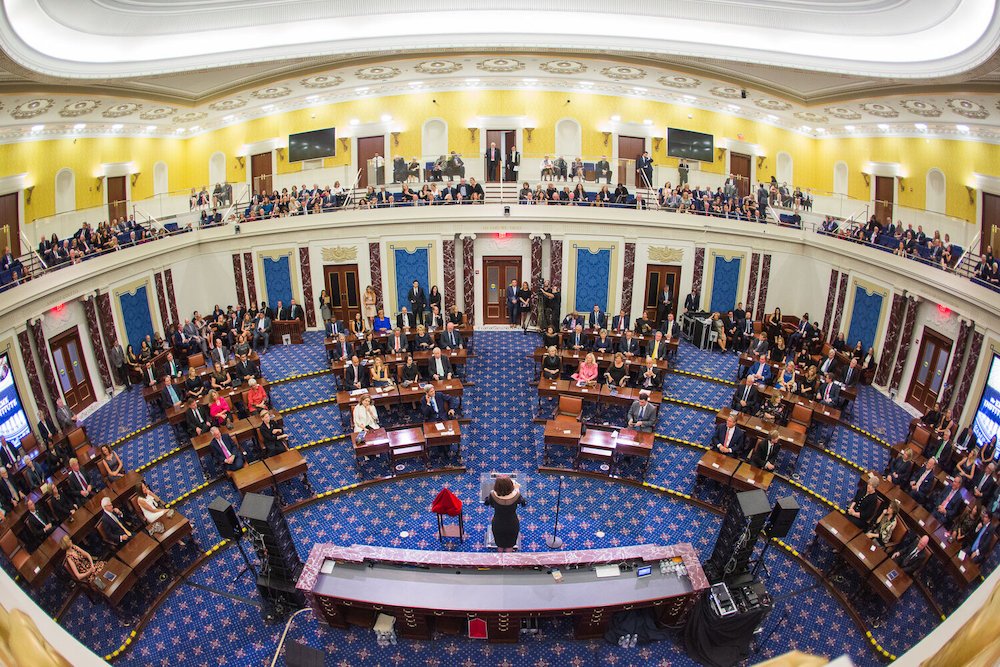
The United States government is composed of a plethora of politicians from all parts of the country. However, although each part of the country is represented, the majority of politicians are men, leaving women underrepresented in politics.
According to the 2025 article “Women account for 28% of lawmakers in the 119th Congress – unchanged from the last Congress” from Pew Research Center, 150 senators and representatives are women, with 125 from the House of Representatives and 25 from the Senate. Though this is a significant increase in female representation from ten years ago, men continue to hold the majority.
With regards to the Executive Branch, no woman has ever served as President, and only one woman, Kamala Harris, has been appointed as Vice President. According to the “Federal Executive” page of the Rutgers Center for American Women and Politics, Hilary Clinton became the first woman major-party candidate in 2016, followed by Kamala Harris as the second woman, first Black woman, and first South Asian woman major-party candidate in 2024.
In a previous article regarding the 2025 election, I discussed the 2018 midterm elections, which were deemed a year for women. For instance, 2018 article from The Guardian, “‘Blue wave’ sweeps Democrats back to majority in House of Representatives,” Alexandria Ocasio-Cortez became the youngest woman elected to Congress at the age of 29, Sharice Davids and Deb Haaland became the first Native American women elected to the House, and with the Democratic majority, Nancy Pelosi reclaimed her position as Speaker of the House.
Additionally, Mendham resident and New Jersey Republican Assemblywoman Aura K. Dunn remains passionate about women in politics. In a conversation with her, she described 2020 as “the year of the Republican women.” She added that it was “a year where we saw a big increase in Republican women not only running for office, but also successfully running, and I actually entered the legislature at that time.”
Dunn’s childhood was a great influence on her future career. She stated, “I was the big sister in a single-family home.” She was nicknamed “the spokesperson,” taking the role of an advocate. “I feel like I was always in that role of being an advocate, a helper, and certainly, you know, [in] many ways, a mediator. As a child of divorce and the oldest child, sometimes you feel like you’re right there in the middle and you’ve gotta work things out,” she added. After graduate school, Dunn received a certificate in mediation. As a certified mediator in the state of New Jersey, she feels it is a highly valuable skill to possess in public policy and policymaking. “What I love most is the ability to help people,” she added, “to restore their trust and faith in government.”
The Assemblywoman has also devoted her time to mentoring her female colleagues who are interested in running for mayor, town council, or even the US Senate. However, she noted that none of this is an easy task. “It is still very much so a male-dominated field. It’s a very egocentric field,” she said. There will always be challenges, but “you got to keep at it.”
As an entity, the country has improved its female representation in government. For instance, Abigail Spanberger won the 2025 Virginia Governor’s Race, and Mikie Sherrill won the 2025 New Jersey Governor’s Race. Also, as a result of the recent election, New Jersey’s Legislative District 25 will be represented by two women: Republican Assemblywoman Aura Dunn and Democrat Assemblywoman Marisa Sweeney.
According to “Governor Mikie Sherrill Issues Six Executive Orders on Day One” from NJ.gov, Sherrill has declared a State of Emergency on utility costs and expanded several state programs to generate massive amounts of energy in New Jersey, established the Office of the Chief Operating Officer within the Office of the Governor to drive efficiency and accountability in the state government, and has created a new office within the Department of Health to increase online safety and prioritize mental health outcomes for children.
Similarly, the article “Governor Spanberger Signs Day One Executive Orders to Make Virginia More Affordable” from the Governor of Virginia’s official website described how Governor Spanberger issued ten Executive Orders on her first day that aim to lower living expenses for Virginians, including her Statewide Affordability Directive, Interagency Health Financing Task Force, and High-Quality Public Education Directive, to name a few.
There is still much to be done with respect to women’s political representation. However, with women supporting other women and the American people supporting women, female representation is bound to increase in the coming elections.