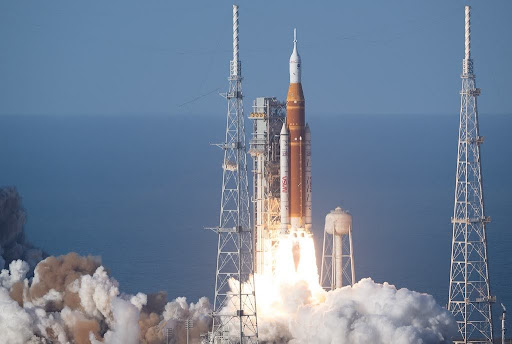


At 6:35 pm EDT on April 1st, four astronauts were launched into the stars, set to orbit the Moon for the first time in 54 years. The crew consisted of Reid Wiseman (Commander), Victor Glover (Pilot), Christina Koch (Mission Specialist 1), and Jeremy Hansen (Mission Specialist 2). The mission lasted 9 days, 1 hour, and 32 minutes, with the crew splashing down on the coast of San Diego on April 11th. Artemis 2 was the second flight of the Space Launch System (two-stage expendable launch vehicle) and the first crewed flight of the Orion spacecraft, named Integrity by the crew.
Artemis has gained significant public traction due to its scientific and cultural achievements. Victor Glover (African American) became the first person of color, Christiana Koch the first woman, Reid Wiseman the oldest, and Jeremy Hansen (Canadian) the first non-U.S. citizen to travel beyond low Earth orbit and around the Moon. For some students, this diverse crew is a large source of inspiration. Indra Balakrishnan, a senior who watched the launch, highlighted Christina Koch as an important figure on the mission. Indra said, “She’s just a very important figure for young girls to have, like they can see themselves in such huge missions, and it’s not just the same men over and over again.” Along with their historic return to the Moon, the astronauts also set the record for human distance from Earth at 252,756 miles. To put that into perspective, that’s around 3.7 million football fields end to end.
On their first day, the crew launched from Kennedy Space Center in Florida into a high Earth orbit. Freshman Chloe Downs was two hours away, in St. Augustine, when she saw the launch. Chloe remembered, “It was really cool, seeing it go up into the atmosphere. I was amazed, but I was also just scared for the astronauts, like, I didn’t want anything to go wrong.” Despite Chloe’s fear, the astronauts successfully made it off the ground and out of Earth’s atmosphere.
Other student reactions from the launch also convey a sense of wonder. Indra commented, “I was really awed. I kind of cried, but it was amazing. Like, it was something huge that we did as a country, and also like, breaking barriers and doing new things.” This coming fall, Indra is planning to study Chemical Engineering at Carnegie Mellon. She is interested in fuel propulsion or the building of rockets. She said that the maneuvers used by the crew inspired her to study these topics in college.
For 24 hours, the crew remained in high elliptical orbit to complete system checks. On day 2, the spacecraft burned its main engine to leave Earth’s orbit and begin its journey to the Moon. For the next three days, the crew performed course corrections, tests, and collected data for NASA. On day 6, Orion entered the Moon’s sphere of influence, where the Moon’s gravity became the main force guiding the trajectory of the spacecraft. The closest Orion flew to the Moon was around 4,067 miles. During the flyby, the crew asked for two unnamed craters to be called Integrity (after their spacecraft) and Carroll (after Wiseman’s late wife). The crew also experienced a solar eclipse, where the Moon covered the Sun.
On the seventh day, Integrity left the Moon’s sphere of influence and began its trip back home. To make this journey, the spacecraft used a free-return trajectory, which uses only gravity as propulsion. They also made a call with astronauts on the International Space Station and NASA science officers.
The next three days were spent making course corrections and preparing for re-entry. On day 10, the crew entered Earth’s atmosphere at a maximum velocity of around 24,664 miles per hour. The compression and friction of Earth’s atmosphere created a plasma bubble that surrounded the craft, resulting in a communication blackout. Outside the capsule, temperatures reached up to 5,000 degrees Fahrenheit. On April 16th, in an interview with ABC News, Glover commented on the intensity of the re-entry, saying the heat was “Literally and figuratively intense.” However, the crew kept their calm and helped support each other through the re-entry. Finally, the four astronauts splashed down on April 11th at 8:07 pm EDT.
The Artemis missions are not over. Looking ahead, Artemis 3 (targeted for 2027) will focus on testing crewed docking with commercial lunar landers in Earth’s orbit. A year later, Artemis 4 will attempt to land on the South Pole of the Moon. When asked about the importance of future missions, senior Anna Goldgirsh mused, “The generation above us, they saw, like a failed launch, and them being able to see a successful one is important to bring back the momentum of wanting to explore, like beyond us.” That momentum can definitely be seen, especially on social media. People are excited for what comes next, and who will be there when it happens. People are eager to see more astronauts who aren’t white males. They are excited to see more female representation in the mission control room. Most of all, they are excited and ready for this new chapter of space travel, where we lay the foundation for lunar surface missions, a Moon base, and even future missions to Mars. Whatever the future holds at NASA, this mission represents humanity’s renewed drive and desire for not only scientific advancements, but also a more inclusive and inspiring future for all.