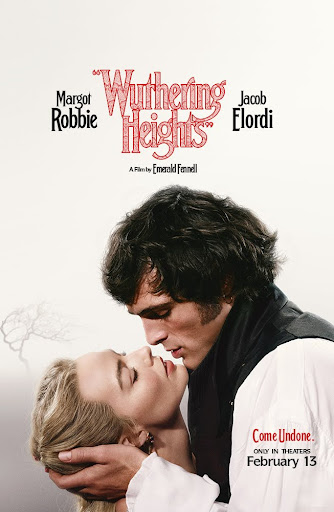
Directed by Emerald Fennell, “Wuthering Heights” caused waves in the film industry after its release on Valentine’s Day. Starring Margot Robbie and Jacob Elordi, the new adaptation of Emily Brontë’s novel grossed around 76.8 million dollars globally for its opening weekend.
Fennell, an English actress, filmmaker, and writer, is adding “Wuthering Heights” to an already stacked repertoire of pieces. Fennell (to name a few) has directed “Anna Karenina” (2012), “Promising Young Woman” (2020), and “Saltburn” (2023). “Saltburn”, another lush yet bizarre film, also made a splash in the industry.
The plot and overall “vibe” of “Saltburn” can be seen as a warm-up for “Wuthering Heights”. Set against the moody English moors, “Wuthering Heights” follows the complex relationship between Catherine Earnshaw (Margot Robbie) and Heathcliff (Jacob Elordi). The two grow up together and form a strong bond after Heathcliff is taken in by Mr. Earnshaw (Catherine’s father). Years later, the family faces financial ruin at the hands of the alcoholic and gambler Earnshaw. In an attempt to save her family, Catherine successfully seduces a very wealthy Edgar Linton. Jealous and angry over the union, Heathcliff leaves that night, leaving Catherine devastated. Five years later, Catherine has settled into married life with Edgar. But when Heathcliff unexpectedly returns, Catherine’s world is flipped upside down. The rest of the movie follows the pair as they attempt to navigate their respective feelings and social situations.
So what is all the commotion about? First, many critics of the film complain that the movie does not accurately portray the novel’s plot and characters. In the text, Heathcliff is a person of color. While his specific race is ambiguous, Brontë utilizes this as a symbol to emphasize his separation from the other white, English characters. However, Fennell chooses to cast Jacob Elordi, a White Australian actor. Critics argue that in doing this, Fennell is disregarding a large plot point in the novel. His race is a large component of his identity, and is one source of the oppression that Heathcliff faces.
Critics also argue that Fennell strays from the plot of the novel. First, Fennell cuts out Hindley Earnshaw, who is Catherine’s brother. Instead, she merges Hindley’s repressive characteristics into Catherine’s father. Additionally, the movie ends roughly halfway through the book. Ms. Cadden, who read the book, shared that, “The book actually follows 3 generations of characters, and the film just focuses on, basically, the one generation of characters. There’s also children of Hindley, Heathcliff, and Cathy in the book, and that’s like, the 2nd half of the book.” This cutoff could be an effort to keep the movie short, but it does leave an opportunity for Fennell to create a sequel.
In terms of positives, many viewers of the film praise Fennell’s cinematography, costume choice, and use of music in the film. The costumes, while not very historically accurate, emphasize the opulent life that Catherine leads after marrying Edgar. Ms. Cadden also commented, “It’s a lot about class, and decisions that people make to preserve their position in society. And so I thought that was an interesting way to kind of explore that.” Additionally, Fennell’s use of synth-pop music instead of more traditional tracks surprised audiences. To some, Charli XCX’s sweeping melodies and strong vocals were a fresh, modern take on the adaptation. Senior Ava Conte appreciated this, saying, “You can tell she [Charli XCX] knew what she wanted to do and how to articulate the feelings of both characters.” Ava went into the movie without any knowledge of the book’s plot. She had only heard mixed reviews of the book online. However, this did not hinder her experience. Instead, she really enjoyed the film, saying, “The aesthetics and the cinematics of everything, it was, like, set in a beautiful place and that’s what really made the movie for me.”
Overall, both Ava and Ms. Cadden didn’t mind the creative liberties that Fennell took with the movie. Instead, they appreciated Fennell’s efforts to reimagine a classic. As an English teacher, Ms. Cadden commented, “The thing I would protest the most is that people are calling it a smooth-brained movie for Gen Z kids, and I think that’s the opposite. I think that anything that gets a classic book like that in the hands of a new generation is good.” As a Gen Z student, Ava also noticed the effects of Fennell’s movies. Ava reflected, “And what I think this director, like what she’s really good at is the cinematic and the aesthetics, like conveying that. Because like, ‘Saltburn summer’…she creates these trends.” Both would see the movie again and would recommend it to anyone else, student or adult.
In my opinion, there are positives and negatives to Fennell’s new film. Her adaptation missed the mark on casting and staying true to the original plot. However, Fennell makes up for these differences with her use of sound and cinematography. The use of a popular artist like Charli XCX brought modernity and “hype” to the movie. Her use of extravagant costumes added a fantastical, otherworldly element. While some people criticize this choice, I think the contrast elevates the film. Like “Saltburn”, the cinematography was beautiful and sometimes shocking, leading to constant interest in the characters and plot.
Those simply looking for a strict, exact interpretation of the novel will be disappointed. But if you can look beyond the changes in plot, characters, and historical inaccuracies, you will find a new take on a beloved classic.